Old souks or glass towers? Creek boats or Marina yachts? This complete guide to Old Dubai vs New Dubai helps you understand both sides of the city and plan your visit right.
Dubai is not one city. It never really was.
There is the Dubai of the textbooks and the travel reels, glass towers climbing out of the desert, an indoor ski slope inside a mall, a hotel shaped like a sail on an artificial peninsula. And then there is the other Dubai, the one that existed before any of that, narrow alleyways carrying the smell of cardamom, wooden boats crossing a saltwater creek that has been doing exactly this for centuries, a gold market with no Wi-Fi password because nobody ever needed one.
Most tourists see one version. The ones who see both leave with something closer to the actual truth of the place.
If you are already in the UAE and trying to figure out how to structure your days, Aureum Tours offers guided experiences across both sides of the city, private and group formats, with hotel pickup and guides who know the difference between showing you Dubai and helping you understand it. Browse the full Dubai tour collection or contact the team to build your itinerary.
QUICK ANSWER BOX (Format this as a highlighted callout on your website)
Old Dubai refers to the historic districts of Deira and Bur Dubai, centered on the Creek, the traditional souks, Al Fahidi, and the original trading settlements that built the city. New Dubai encompasses Downtown, the Marina, Palm Jumeirah, and the modern development corridors that emerged after the oil era. Both are worth visiting. They tell completely different stories about the same place, and the contrast between them is, genuinely, the whole point.
Why the Distinction Matters More Than Most Travel Guides Admit
Calling it Old Dubai versus New Dubai is slightly reductive, if useful. The reality is more layered than a binary.
The Creek area did not stop evolving when the towers went up somewhere else. Al Fahidi is still a functioning neighbourhood, not a heritage theme park. The Spice Souk is still an actual spice market, not a reconstruction of one. Meanwhile, some of the newest districts in Dubai contain mosques and cultural institutions and schools where the traditions of the older city continue in a modern architectural vocabulary.
But the distinction is real enough to be worth making because it shapes how you experience the city depending on which parts you prioritise. Old Dubai asks you to slow down. It rewards wandering and getting slightly lost and talking to vendors who have been in the same stall for thirty years. New Dubai rewards ambition and spectacle and the feeling of standing somewhere that did not exist twenty years ago.
Both of those are legitimate travel experiences. The question is what you came for, and how much time you have to get it.
Old Dubai: What It Is and What It Gives You

Old Dubai is the city as it was before oil, before the property boom, before the airlines started listing it as a global hub. It is, depending on how you approach it, either a preserved relic or a living neighbourhood. The answer is somewhere between the two and shifts depending on which street you are on.
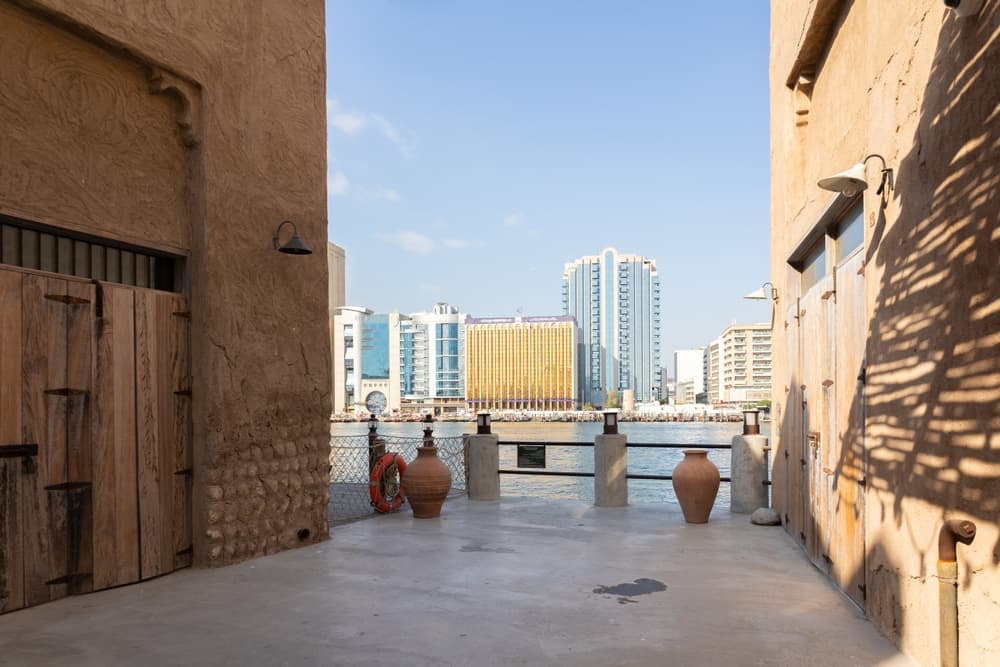
The geographic core is the Dubai Creek, the natural saltwater inlet that made Dubai a viable trading settlement in the first place. On one side of the water sits Deira, historically the commercial hub, still home to the gold and spice markets that gave the city much of its original character. On the other side sits Bur Dubai, where the original fort, the oldest mosque, and the narrow lanes of Al Fahidi neighbourhood tell the story of what the city looked like before concrete arrived.
The Creek itself is the first thing to experience. An abra, the traditional wooden ferry that has been crossing this water for generations, takes you from one bank to the other for one dirham. The journey lasts about ten minutes. In those ten minutes you see the city in a way that no vantage point in New Dubai can replicate, low to the water, surrounded by the activity of a working waterfront, the scale of everything human rather than architectural.
The Gold Souk sits a short walk from the Deira creek landing. Over 300 retailers. Around 10 tons of gold on display at any given moment. It is real and working and slightly overwhelming in the best possible way. The covered arcade channels the light onto the display cases in a way that makes the whole corridor glow. Even if buying nothing is the plan, walking through it is an experience worth protecting an hour for.
The Spice Souk is five minutes on foot from the Gold Souk and operates on a completely different register. Quieter. Darker inside. The smell reaches you before the entrance does. Saffron in loose pyramids, frankincense in ceramic pots, dried limes and rose petals in open baskets. The vendors here are not performing for tourists. They are running businesses that have been running in this form for a very long time.
Al Fahidi Historical Neighbourhood is the most intact piece of pre-oil Dubai remaining. The wind tower architecture, coral and gypsum construction, narrow lanes designed to channel breeze rather than sunlight, these are not reconstructions. They are original buildings preserved within a city that demolished almost everything else around them. The Dubai Museum inside Al Fahidi Fort is small, inexpensive, and genuinely good, especially the underground sections on pearl diving and Bedouin life. The fort dates to 1787.
What Old Dubai gives you, more than specific landmarks, is context. The towers make more sense when you understand what the city was before them. The ambition of New Dubai reads differently when you have stood in the alley where the original Dubai happened.
New Dubai: What It Is and What It Gives You

New Dubai is the part of the city most of the world sees first, usually in photographs taken from helicopters or from the 124th floor of the tallest building humans have ever constructed.
The development that created New Dubai began seriously in the 1990s and accelerated dramatically through the 2000s. In roughly twenty years, a coastline of undeveloped desert became one of the most recognisable skylines on earth. The speed of it is, in its own way, as historically significant as anything in the old city.
Downtown Dubai is the natural starting point for New Dubai. The Burj Khalifa stands at the centre of it, 828 metres tall, the kind of scale that takes several minutes of standing next to it before the number connects with the physical reality. The Burj Khalifa At the Top experience puts you on the 124th floor observation deck where, on a clear day, the curvature of the earth is actually visible. Book the late afternoon slot. The light at that height in the hour before sunset is something else entirely.
The Dubai Fountain performs in front of the Burj Khalifa every 30 minutes from 6 PM onward. Free to watch from the outdoor promenade. 150 metres of illuminated water moving to music. It is the kind of thing you expect to find underwhelming and do not.
Dubai Marina is the urban planning achievement of New Dubai that hits hardest at ground level. Eighty-plus towers arranged around a 3.5-kilometre artificial canal, the Marina Walk running the full length of the water, the whole thing designed to be experienced on foot. It is most alive in the evening when the heat drops and the reflections of the towers appear in the water below them.
Palm Jumeirah makes the most sense seen from above, which is part of why the Burj Khalifa visit and a Palm visit pair naturally together. From the ground, on the monorail from the Gateway station at the trunk to the Atlantis at the tip, the scale becomes real in a different way. The view of the Dubai skyline from the far end of the Palm, the towers small and distant across the water, is one of the best perspectives on the city available anywhere.
What New Dubai gives you is a specific kind of awe. The feeling of standing somewhere that was not there a generation ago. The understanding that what looks like excess from the outside looks like genuine ambition from within. It is not subtle. But it is not pretending to be.
The Real Difference Between the Two Experiences
Old Dubai asks something of you. It asks you to slow down, to engage with vendors and guides and the logic of a space built for commerce and community rather than spectacle. It requires some tolerance for heat, narrow lanes, and the absence of air-conditioning between every stop.
New Dubai delivers without demanding much in return. The towers are spectacular whether you understand the context or not. The fountain performs on a schedule. The observation deck works the same way for every visitor regardless of preparation.
Neither of those is a criticism. They are accurate descriptions of the emotional register each side of the city operates in.
The travelers who come away from Dubai most satisfied are almost always the ones who spent meaningful time in both. Old Dubai gives New Dubai its depth. Without the Creek and the souk and the fort, the towers are just towers. With that context, they are the logical continuation of a city that has been building itself with extraordinary energy for a very long time.
How to See Both in One Day
It can be done, and done well, if the day is sequenced properly.
Start in Old Dubai. The Creek, the souks, Al Fahidi, the museum. Morning is the right time for this side of the city. The light is better, the heat is more manageable, and the souks are active without being overwhelming.

Move to New Dubai in the afternoon. The Jumeirah Mosque as a transitional cultural stop, then the Marina for a walk and a coffee, then Downtown for the Burj Khalifa visit timed to catch the late afternoon light. Stay for the fountain show at 6 PM.
This is the sequence that Aureum's full-day Dubai city tours are built around. Hotel pickup, a guide who knows both sides of the city and how to connect them for visitors encountering it for the first time, and transport that makes the geography work without burning an hour in traffic between each stop.
For context on how this fits into a longer UAE trip, the complete guide to planning a day in Abu Dhabi from Dubai pairs naturally with this one, as does the Hatta Full Day Private Tour for a third day that shows a completely different face of the emirate entirely.
The complete evening desert safari guide is also worth reading before the trip if the plan is to end a Dubai day in the desert, which it should be at least once.
Which Should You Prioritise If Time Is Limited?
If you have one day and one day only in Dubai, do both halves of it rather than spending the entire day in either one.
Old Dubai in the morning takes roughly three to four hours to cover properly: the Creek crossing, an hour in the souks, ninety minutes in Al Fahidi. That leaves the afternoon and evening for Downtown, the Burj Khalifa, and the fountain. The contrast between those two halves, experienced in the same day, is the closest thing Dubai has to a complete introduction.
If you genuinely only have half a day, the choice depends on what you came for. History, culture, and the sense of a city with roots: Old Dubai. Spectacle, scale, and the feeling of standing somewhere extraordinary: New Dubai. Both are worth the time they take. Neither is a consolation prize.
The Honest Answer to the Old vs New Question
There is no better side of Dubai. That question is almost always asked by people who have only seen one of them.

The city does not make sense as New Dubai alone. The towers without the Creek are photographs without captions. And Old Dubai alone, while genuinely extraordinary, does not prepare you for the emotional experience of standing on the 124th floor of the Burj Khalifa and looking down at everything that grew up around it.
The two sides of this city were always going to be in conversation with each other. The traveler who understands that gets a version of Dubai that most people, even people who have been here multiple times, have never quite reached.
Aureum Tours designs Dubai experiences that treat both sides of the city with the attention they deserve. Whether you want a private full-day tour covering the complete range, a half-day focused on Old Dubai specifically, or a tailored itinerary built around exactly how many days you have, the team can build it.
Book a Dubai city tour here. Browse all available Dubai experiences. Or speak to the team directly before you arrive and arrive with a better plan than most tourists manage.
Frequently Asked Questions
What is the difference between Old Dubai and New Dubai?
Old Dubai refers to the historic districts of Deira and Bur Dubai, centred on the Creek, the traditional souks, and Al Fahidi neighbourhood, the parts of the city that predate the oil era. New Dubai refers to the modern development areas: Downtown, Dubai Marina, and Palm Jumeirah, built primarily from the 1990s onward. Both are within the same city but feel like completely different places.
Is Old Dubai worth visiting in 2026?
Yes, without qualification. Old Dubai offers an experience that no other part of the city replicates. The Creek, the Gold Souk, the Spice Souk, and Al Fahidi neighbourhood are living, functioning environments with genuine historical depth. They are also significantly less crowded and less expensive than the major attractions in New Dubai, which makes them easier to enjoy at a real pace.
How long does it take to see Old Dubai?
A proper visit to Old Dubai, covering the Creek crossing, both souks, and Al Fahidi neighbourhood with the Dubai Museum, takes approximately three to four hours at a comfortable pace. Rushing it in two hours is possible but misses most of what makes the area worth visiting.
Can you walk between Old Dubai and New Dubai?
Not comfortably. The two areas are separated by several kilometres of city. Within Old Dubai, most key sites are walkable from each other. The move from Old Dubai to Downtown or the Marina requires a taxi, the metro, or a tour vehicle. This is one of the practical reasons a guided tour with transport makes the combined day significantly easier.
What is the best area to stay in Dubai for first-time visitors?
Downtown Dubai puts you within walking distance of the Burj Khalifa and the fountain and in easy taxi distance of Old Dubai. Dubai Marina offers a more residential feel with excellent walking infrastructure. Both are solid choices. Old Dubai itself has fewer hotel options but staying near the Creek gives you immediate access to the most atmospheric part of the city in the early morning.
How do I book a guided Old and New Dubai tour with Aureum?
Visit aureumtours.ae/booking to book directly, or contact the team via WhatsApp to discuss a customised itinerary. Hotel pickup from anywhere in Dubai is included in all city tour formats.
Dubai contains two entirely different cities and most tourists only see one. Let Aureum show you both, from the creek to the cloud, in a single guided day.